Brief Stops, More Vortices
Isaiah Bascom, Min Wang, Yuhe Wang · talk at the Gulf Coast Undergraduate Research Symposium (GCURS), Rice University, October 2026
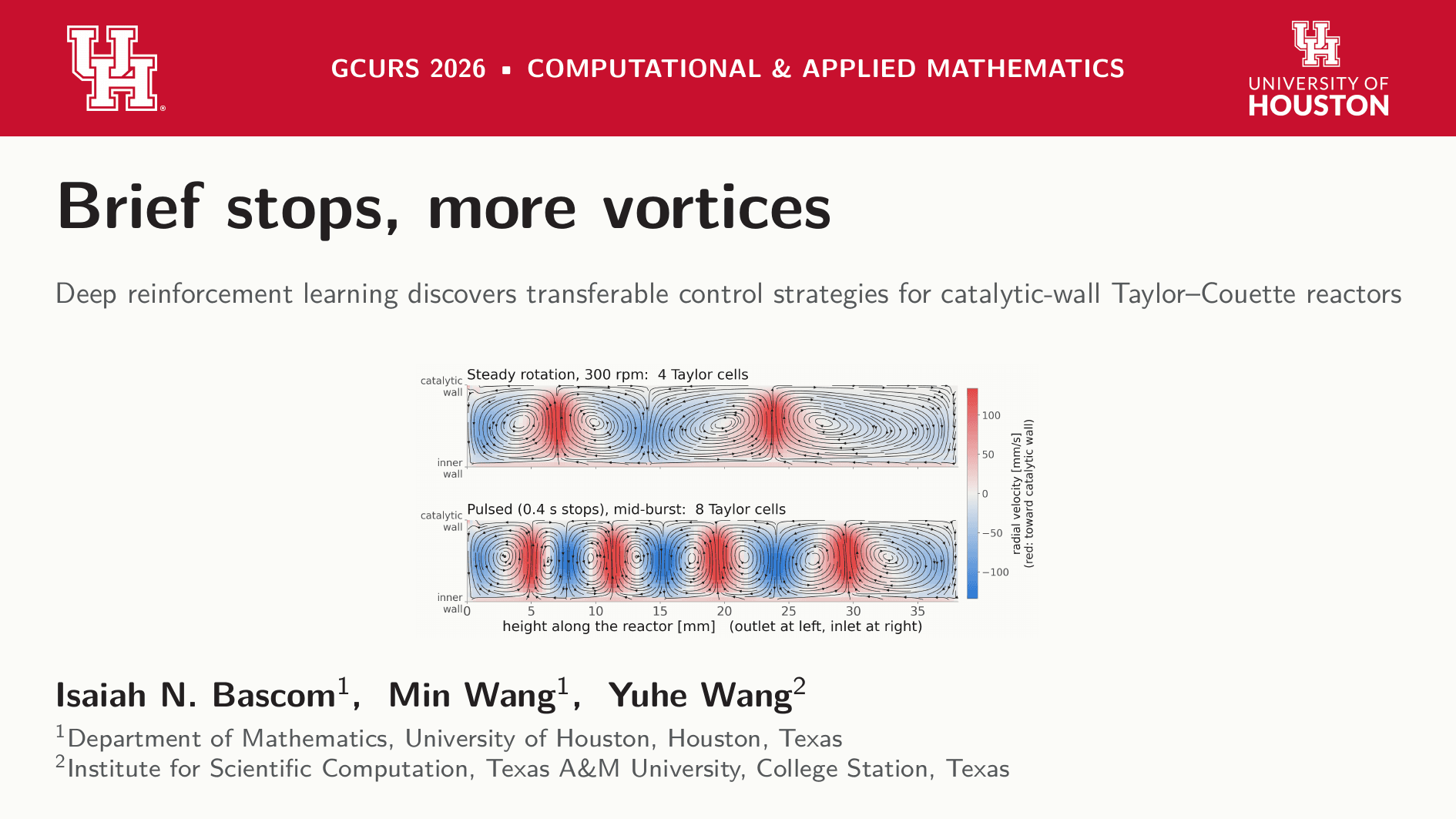
In a catalytic-wall Taylor-Couette reactor, liquid fills the gap between a spinning inner cylinder and a catalyst-coated outer wall. The reaction only happens at that wall, so performance depends on how fast the Taylor vortices in the gap carry reactant to it. The question: with the average speed held fixed, how should the inner cylinder be spun over time?
A TD3 reinforcement learning agent, coupled to an OpenFOAM simulation and given no physics, learned the same strategy in all five training runs: run a little above 300 rpm for about four and a half seconds, then stop completely for about half a second. An independent Bayesian optimization over 220 fixed waveforms found the same thing. The policy transferred with no retraining to a reactor five times taller, reaching 0.90 conversion against 0.79 for steady rotation at the same power, while the previously published recipe of long idles and short bursts lost to steady rotation.
The second half of the talk explains why. A short Taylor-Couette annulus is multistable: at the same speed it can settle into different numbers of vortex cells. Steady rotation gives four cells. Each brief stop lets the vortices die, and the restart from rest builds eight narrower cells, which carry reactant to the wall faster. Under steady rotation the extra cells merge back to four within 10 to 15 seconds, so the stops have to keep coming, and they have to be full stops: slowing to 100 rpm or more instead of stopping loses the gain entirely.