Catalog of Definitions. Used Fraleigh's "A First Course in Abstract Algebra" as reference.
Definition 1. Group
A group is a set Galong with a binary operation ∗ such that:1. (Closure) ∀a,b∈G,a∗b∈G2. (Associativity) ∀a,b,c∈G,(a∗b)∗c=a∗(b∗c)3. (Identity) ∃e∈G such that ∀a∈G,e∗a=a∗e=a4. (Inverse) ∀a∈G,∃a−1∈G such that a∗a−1=a−1∗a=e,
Definition 2. Subgroup
Let G be a group. A subset H⊆G is a subgroup if:1. The identity e∈H2. If a,b∈H, then ab∈H3. If a∈H, then a−1∈H
Definition 3. Homomorphism
Let G and K be two groups.A map ϕ:G→K is called a homomorphismif ∀a,b∈G,ϕ(ab)=ϕ(a)ϕ(b)To be homomorphic haiku:operate then mapmust give the same result asmap then operate
Definition 4. Isomorphism
An isomorphism is a bijective homomorphism.Written as G≅K, where G and K are groups.
Definition 5. Kernel of a Homomorphism
Let ϕ:G→K be a homomorphismbetween groups G and K.The kernel of ϕ is the set:ker(ϕ)={x∈G∣ϕ(x)=eK}
Definition 6. Normal Subgroup
A subgroup H of a group G is called normal (H⊴G)if ∀g∈G,∀h∈H,ghg−1∈H.H⊴G if H⊆G.H◃G if H⊂G.
Definition 7. Generating Set
Let G be a group and let S⊆G be nonempty.Denote S−1={a−1∣a∈S}.Then ⟨S⟩={x1x2...xn∣n∈N,xi∈S∪S−1∪{e}}.⟨S⟩ is created by choosing different n’sand finding the product of 1 through n elements of S∪S−1∪{e}.For a single element:⟨g⟩={gn∣n∈Z}
Definition 8. Finitely Generated Group
A group is finitely generated ifthere exists a finite nonempty subset of Ss.t. G is generated by S.In other words, G=⟨S⟩.
Definition 9. Cyclic Group
A group G is cyclic if the group is generated by a single element. i.e. if G=⟨a⟩ for some a∈G.
Definition 10. Relation
Let X be a set.A relation on X is a subset of X×X.In other words, a relation is an ordered pair.For example, the point (1,2) relates 1 and 2 in R2.You would write 1∼2 in this case.
Definition 11. Properties of Relations
A relation on X is said to be:1◯ reflexive: if x∼x∀x∈X2◯ symmetric: if x∼y⟹y∼x∀x,y∈X.3◯ transitive: if x∼y∧y∼z⟹x∼z∀x,y,z∈X4◯ anti-symmetric: if x∼y∧y∼x⟹x=y∀x,y∈X.
Definition 12. Order Relation
An order relation (or partial order) on Xis a relation that is reflexive, antisymmetric, and transitive.a≤b and a∣b (a "divides" b)are examples of order relations.
Definition 13. Equivalence Relation
An equivalence relation on Xis a relation that is reflexive, symmetric, and transitive.For example,say two M&Ms are the same if they have the same colorThis is denoted as a∼b⟺(a has same color as b).Considering different equivalence relations on a setgives different partitions.So a single set can be observed in many different ways.
Definition 14. Equivalence Class
Given an equivalence relation ∼ on a set X,the equivalence class of x∈X is the set:[x]={y∈X∣x∼y}This was presented as a theorem:1)∀x,y∈Xif x∼y then [x]=[y]if x∼y then [x]∩[y]=∅.2)x∈X⋃[x]=X.
Definition 15. Left Coset
Let H≤G and x∈G.The set {xh∣h∈H} is called the left coset by x.Written as xH.
Definition 16. Automorphism
An automorphism is an isomorphism that maps from G to G.Aut(G) is the set of all automorphisms of G.
Definition 17. Inner Automorphism
An inner automorphism is an automorphism of the form ϕg:G→G,defined by ϕg(x)=gxg−1 for x,g∈G.We denote Inn(G)={ϕg∣g∈G}as the set of all inner automorphisms of G.
Definition 18. Symmetric Group
Let X be a set. Let SX={f:X→X∣f is bijective}.SX with composition is called the symmetric group.For n∈N and X={1,2,...,n},We denote Sn for SX.For example, S2 is the group of bijective functions over X={1,2},and only has two elements:the identity function and a single transposition.In other words the only actions you can do in S2is stay in place or swap places.Even more generally,Sn has n! permutations.
Definition 19. Permutation
A permutation is a bijective mapping from a set onto itself
Definition 20. Cycles
A cycle is a simple way to represent a permutation.Given a permutation σ∈S4,Define σ=(1234)This notation means 1→22→33→44→1σ=(12)(34) means1→22→13→44→3σ=(12) means1→22→13→34→4
Definition 21. Cycle Multiplication
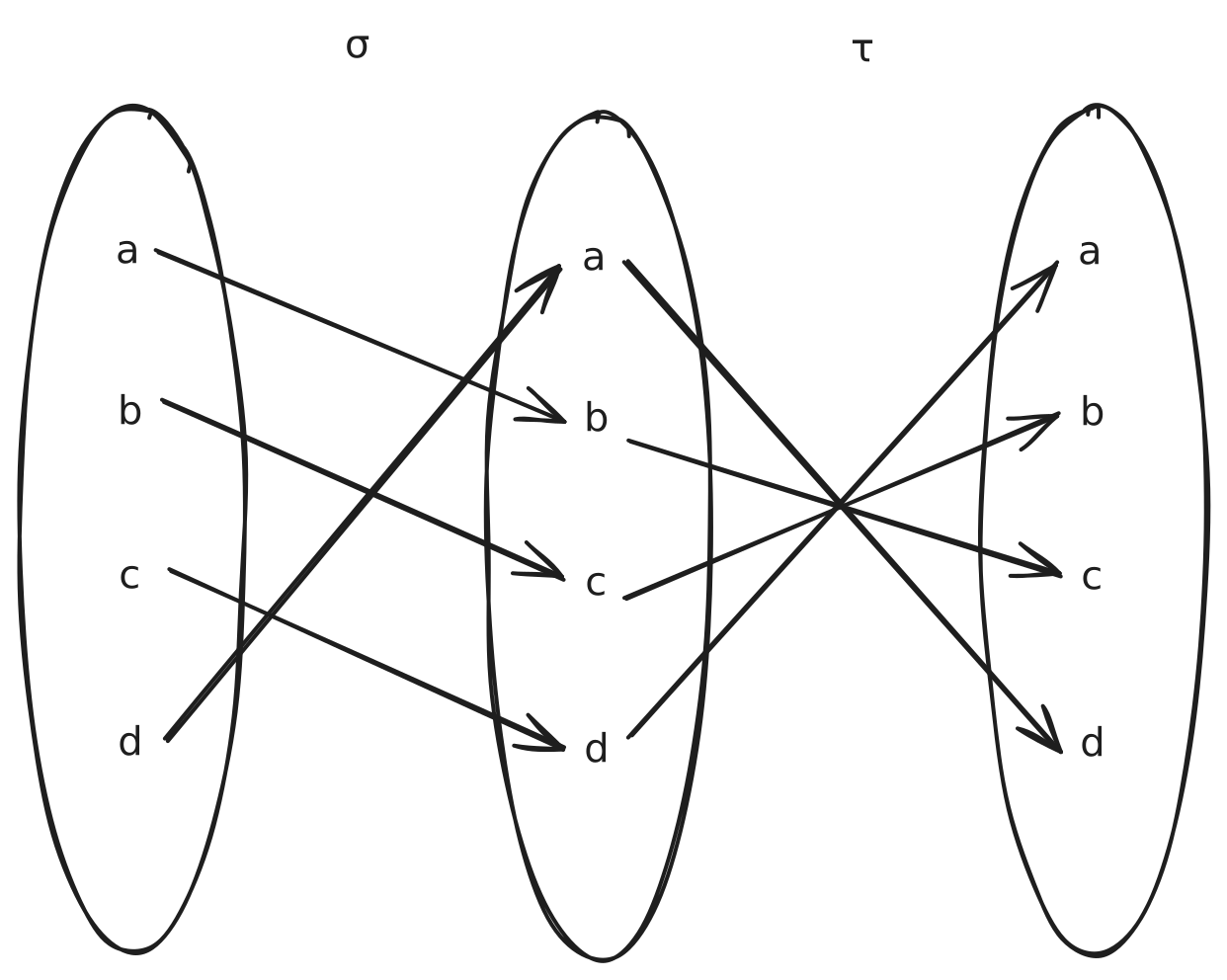
To multiply cycles you compose the two permutationsστ can be read as apply σ and then apply τ.Let σ,τ∈S4 withσ=(abcd) and τ=(ad)(bc).To find στ,we evaluate τ∘σ or τ(σ).Can be written as ((ad)(bc))(abcd).Starting with a the first element in σ,aσb then bτccσd then dτaThis means a and c forms a cycle (ac).Now we go to the next element we haven’t evaluated.bσc then cτb.So b is in a 1-cycle, because it maps to itself.Finally we evaluate d,dσa then aτd.Therefore, our final product is (ac).
Definition 22. Transposition
Let n≥2.A transposition is a permutation τ∈Snof the form (ij) for 1≤i=j≤n.
Definition 23. Even or Odd Permutation
A permutation is called even ifit is a product of an even number of transpositions.A permutation is called odd ifit is a product of an odd number of transpositions.
Definition 24. Index
Let H≤G.The index of H in G isthe cardinality of the coset space ∣G/H∣.Denoted by [G:H].
Definition 25. Direct Product of Groups
Let G1,G2 be groups with g1∈G1 and g2∈G2.The direct product G1×G2is the group of ordered pairs (g1,g2)with the binary operation (g1,g2)⋅(h1,h2)=(g1h1,g2h2)called the cartesian productFor example the point (1,2)is an element in R2and R2=R×R.
Definition 26. Ring
A ring is a set Requipped with two associative binary operations+:R×R→R,⋅:R×R→R satisfying:1)(R,+) is an abelian group2)∀a,b,c∈R,(a+b)⋅c=(a⋅c)+(b⋅c)a⋅(b+c)=(a⋅b)+(a⋅c).
Definition 27. Commutative Ring
A ring R is commutative ifxy=yx∀x,y∈R.
Definition 28. Unital Ring
Put simply, a ring is unital if it has both neutral elements.Let (R,+,⋅) be a ring.We say R is unital if it hasa neutral element for the operation ⋅.We denote the neutral element of (R,+) with 0and the neutral element of (R,⋅) with 1
Definition 29. Zero Divisor
A non-zero element x∈R is a zero divisor ifthere exists another non-zero element y∈Rsuch that xy=0.In non-commutative rings this is called the left zero-divisor.In commutative ringsleft and right zero-divisors are the same.
Definition 30. Integral Domain
A Ring R is an integral domain ifR is a untial commutative ring andR has no zero divisors.
Definition 31. Division Ring
R is a division ring ifR is a unital ring and(R−{0},⋅) is a group.This is if every non-zero elementhas a multiplicative inverse for this operation
Definition 32. Field
A commutative division ring is called a field.
Definition 33. Subring
Let (R,+,⋅) be a ringA subset S⊆R is called a subring if:1)(S,+) is a subgroup of (R,+)2)∀x,y∈S, we have x⋅y∈S.
Definition 34. Ring Homomorphism
Let R and S be ringsand ϕ:R→S be a map.We say ϕ is a ring homomorphismif ∀a,b∈R.1)ϕ(a+b)=ϕ(a)+ϕ(b)2)ϕ(ab)=ϕ(a)ϕ(b)
Definition 35. Kernel of Ring Homomorphism
Let ϕ:R→S be a ring homomorphism.The kernel of ϕ is ker(ϕ)={r∈R∣ϕ(r)=0}.
Definition 36. Ideal
Let I≤R.I is an ideal in Rif ∀a∈R and x∈I,we have ax∈I and xa∈I.In this case we write I⊴R.An ideal I◃R is proper if I=R.
Definition 37. Quotient Ring
R/I is the set of cosets of I with respect to +.Denote R/I={r+I∣r∈R}.For R/I to be a ring I must be an ideal of R.This is equipped with the operations:(x+I)+(y+I)=(x+y)+I and(x+I)⋅(y+I)=(xy)+I.
Definition 38. Maximal Ideal
I◃R is maximal if I=R,and if J◃R s.t. I⊆J⊆R,then either J=I or J=R.
Definition 39. Polynomial Ring
The polynomial ring R[x]has polynomial elements of the formp(x)=anxn+an−1xn−1+...+a1x+a0with a0,a1,...,an∈R and an=0.
Definition 40. Division Algorithm
Given polynomials, p(x) and q(x)there are polynomials a(x),r(x)s.t. q(x)=p(x)a(x)+r(x).Where either r(x)=0 or deg(r(x))≤deg(p(x)).
Definition 41. Principal Ideal
A principal ideal ⟨x⟩ is an ideal in a commutative ring R generated by x∈Rwith ⟨x⟩={rx∣r∈R}.For example, ⟨6⟩ is a principal ideal.Because ⟨6⟩={n⋅6∣n∈Z}
Definition 42. Principal Ideal Domain (PID)
A PID is an integral domain Rs.t. every ideal of R is principal.
Definition 43. Divides Notation
Let R be a ring and 0=a,x∈R.We write a∣xiff ∃b∈R s.t. x=ab.3∣6 becase 3⋅2=6.
Definition 44. Invertible Element
An element a∈R is invertibleif there exists an element b∈Rs.t. ab=1.An element a∈Zn is invertible iffgcd(a,n)=1.If n is primethen every element in Zn is invertibleFor example,in Z6 both 1 and 5 are invertible.1⋅1≡1(mod6)5⋅5=25≡1(mod6)inverse of 1 is 1 and inverse of 5 is 5.
Definition 45. Prime Element
Let R be a commutative ring.An element p∈R is said to be prime ifit is not the zero element or the one elementand whenever p∣ab∀a,b∈R, then p∣a or p∣b.
Definition 46. Irreducible/Prime Element
Let R be an ID.A non-zero and non-invertible (not one) element x∈Ris called irreducible iff whenever a,b∈R and x=ab,then either a is invertible or b is invertible.This is saying thatan irreducible element cannot be factoredas two non-invertible elements.In Unique Factor Domains (UFDs)irreducable and prime is the same.So for our purposes treat them as having both properties.
Definition 47. Prime Ideal
Let R be an ID.A proper ideal I◃R is called primeiff whenever ab∈R and ab∈Ithen either a∈I or b∈I.For example,6Z⊴Z is not a prime ideal.By choosing 2,3∈Z, we have 2⋅3∈Z and 2⋅3∈6Z.However, neither 2 or 3 are in 6Z.7Z is an example of a prime ideal.Since 7 is a prime integer, its only factors are 1 and 7.
Definition 48. Group Action
Let G be a group and let X be a set.An action of G on X isa group homomorphism α:G→SX.For each g∈G and x∈Xwe denote gx=α(g)(x).An example is rotations of a snowflake.
Definition 49. Kernel of Action
The kernel of the action is ker(α)={g∈G∣gx=x∀x∈X}In other words, the kernel is the set ofelements of G that when acted upon x dont change x.For example, taking the group Z6.and the set Z3. Let n∈Z6 and x∈Z3.Define the action gx:=(n+x)(mod3).ker(α)={0,3}.If n=0, then 0⋅x=(0+x)(mod3)=x.So 0 is in the kernel.If n=1, then 1⋅0=(1+0)(mod3)=1.So 1 is not in the kernel.
Definition 50. Faithful Action
An action is faithful if the kernel is trivial.If ∀g∈G where g=e,∃x∈X s.t. gx=x,then the action is faithful.Or in other words, whenever ker={e}.So when an action is faithful,we can tell different elements of G apart.In the previous example of G=Z6 and X=Z3the action of mod 3 addition is not faithful.Because ker(α)={0,3}={0}.An example of a faithful action would begx:=(g+x)(mod3)with G=Z3 and X={1}.0⋅1=(0+1)(mod3)=11⋅1=(1+1)(mod3)=22⋅1=(2+1)(mod3)=3
Definition 51. Free Action
An action is free if∀g∈G where g=e, every x∈X satisfies gx=x.For example, chooseG=GLn(R) and X=Rn.Let A∈G and v∈X.Define Av:=Av (matrix multiplication).This is faithful since every matrixis a unique linear transformation.However, the action is not free becauseany matrix multiplied by the zero vector is the zero vector.
Definition 52. G-set
A G-set is a setXalongside a group action of a group G on X.
Definition 53. G-orbits
The G-orbits of x is the setGx={gx∣g∈G}.Can be thought of as the set of positionsyou can move x to by applying group elements.
Definition 54. Stabilizer
The stabilizer of x is the setGx={g∈G∣gx=x}The set of elements of Gthat don’t move our given x.The kernel is the set of elements of Gthat don’t move any x.So ker⊆Gx.
Definition 55. Fixed Points
Given a G-set X, the set of fixed points isdenoted as XG={x∈X∣gx=x∀g∈G}.For example, letG=S3 and X=R[x1,x2,x3].For σ∈S3 and p(x1,x2,x3)∈R[x1,x2,x3]Define σp:=p(xσ(1),xσ(2),xσ(3)).So XS3={p∈R[x1,x2,x3]∣σp=p∀σ∈S3}.XS3=R[e1,e2,e3].R[e1,e2,e3] is the set of symmetric polynomials.Look up the fundamental theorem of symmetric polynomials.
Definition 56. Poset
A partially ordered set (AKA poset)is a pair (P,≤)where P is a set,and ≤ is an order relation on P.However, not every pair of elements needs to be comparable.
Definition 57. Upper Bound of a Poset
Let (P,≤)be a poset and A⊆P.An upper bound for Ais an element m∈P s.t. p≤m∀p∈P.
Definition 58. Chain
A chain in (P,≤) is a subset C∈Ps.t. ∀x,y∈C,x≤y or y≤x.